
Psychological support following a tragedy
Although it is hoped that a school will not experience a tragedy such as a student or staff member’s death, it is critical to be prepared should such an event occur. School and district personnel play a crucial role in helping students manage their reactions after a crisis incident.
The OCPS Student Services Department district team members (school social workers, school psychologists, and district mental health counselors) serve as grief counselors when supporting students.
When a district team needs to be activated, contact Student Services administrators, specifically Carl Sousa (carl.sousa@ocps.net). As part of the request, share as many details of the situation as possible so district team members can prepare to plan and provide support.
Not all crisis situations are the same, and not all situations need the same type of response. Not all students and staff will be equally affected, and different individuals will require different levels of intervention. Best practice indicates that crisis intervention assistance should only be offered in response to a demonstrated need.

Questions? Contact Carl Sousa, Director, Psychological Services, or Lisa Coffey, Director, Social Services (lisa.coffey@ocps.net).
Get help now
988 offers mental health and substance use support, suicide prevention and crisis de-escalation, and connection to local care. 911 is for medical emergencies, fire, crime in progress, and life-threatening situations. Together, they provide whole-person care.
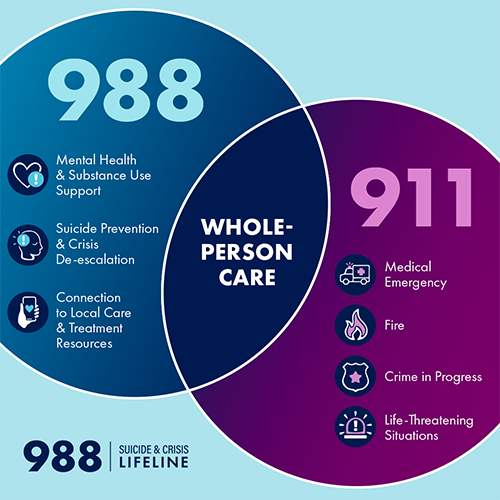
When to call 988 and when to call 911.

The Veterans Crisis Line is for Veterans and their loved ones. Dial 988 then press 1, text 838255, or chat at
VeteransCrisisLine.net/Chat.
Administrator Resource Toolkit
Internal supports for administrators:
- Employee Assistance Program
- Mentor administrators
- Trusted supervisors
- District resources
- Peer support network
- Crisis SharePoint
Memorial and memorialization guidance
The loss of a member of the school community can significantly impact students, staff, and families. Memorials recognize and honor the deceased, the survivors, and the community members who supported them. They set a precedent, so they need to be equitable from case to case, considerate of the grief process, and aligned with best practices and research. School leaders are encouraged to contact Student Services for guidance.
School memorials should be simple, meaningful, and life-affirming. Permanent memorials in schools are not recommended; temporary and timely activities are encouraged.
- Memorial or gathering sites should be physically and emotionally safe. Do not allow students to gather at an accident site beside a busy road.
- Keep candles separate from stuffed animals, flowers, letters, and poems.
- Let students’ questions be the guide; do not force anyone to discuss or attend before they are ready.
- Approved by the principal in consultation with Student Services Administration and district leadership.
- May be displayed until the day of the funeral, but no longer than one week after the death, then given to the family.
- Allowed: flower arrangements, banners, memory books, pictures, notes, cup signs, and collections of objects, in locations approved and monitored by school officials.
- Informal gatherings such as candlelight vigils need school and district approval and must occur outside school hours.
- The principal may remove items that violate School Board policy, the student code of conduct, or are likely to cause substantial disruption.
- Not typically held by schools or the district; community partners are recommended, with family consent.
- Examples: joining an awareness or fundraising event, buying related books for the library, volunteering for a related cause.
- Held outside the school day. On school property, limited to memorial services and candlelight vigils under the Facility Use Handbook.
- A cap, gown, tassel, program, and single flower may be placed on the last chair, acknowledged with a general comment about loss.
- The student’s name may be read (“In memory of…”) with a short pause; alert the next student in line.
- On parent/guardian request, diplomas, posthumous diplomas, or certificates can be awarded, accepted by family outside the ceremony. A diploma plaque may be purchased for the family.
- Highly discouraged: risk of re-traumatization, future perception, and long-term maintenance costs.
- In rare cases, approval by the Superintendent and Cabinet is required. They may not retire or alter School District property.
- The District may accept or decline them. Board Policy FF covers naming of buildings and facilities.
- Flags: lowered only per Florida law and policy.
- Funeral service: students may attend with parental permission and make up missed work.
- Yearbooks: on family request, name, photo, dates of birth and death, and school activities.
- Donations and scholarships: handle through The Foundation for OCPS.
- Moments of silence: not typically school-wide; Florida statute 1003.45 provides 1–2 minutes daily in first period, and teachers may not suggest the nature of reflection or encourage or discourage prayer.
- School marquee messages about the deceased.
- Large memorial assemblies or formal school-wide recognition of anniversary dates.
- Memorials after a suicide that glamorize, romanticize, or stigmatize the act.
- Permanent memorials that use public funds, alter school property, or take the form of monuments, statues, markers, benches, tables, outdoor furnishings, sidewalks, stepping stones, or photographs.
- Balloon releases (CS/HB 321) and similar activities.
- Scattering cremains on district property.
- Memorials established before this guidance may remain as originally accepted.
- District staff and funds may be used only for regular maintenance and safety. The district may move, replace, or remove a memorial that cannot be maintained or conflicts with students’ educational needs.
Contact: Mary Bridges (mary.bridges@ocps.net), Carl Sousa (carl.sousa@ocps.net), Lisa Coffey (lisa.coffey@ocps.net).
Employee Assistance Program
The Cigna Employee Assistance Program (EAP) is available to OCPS employees and their household members at no cost. It is confidential and open 24/7. EAP personal advocates help resolve issues, connect you with mental health professionals, and direct you to community resources. Licensed consultants are available by phone for routine or urgent concerns.
Counseling: up to 5 face-to-face or video sessions per issue per year. Phone consultations run 20 to 30 minutes, with unlimited consultations each year. The Managing Stress Toolkit offers self-assessments, on-demand seminars, and mindfulness exercises.
We’re here to listen. Contact us any day, anytime.
877-622-4327
Or log in to myCigna.com. Employer ID: ocps (needed for initial registration only). If already registered, go to the EAP link under the Review My Coverage tab.
Legal
30-minute attorney consultation, in person or by phone. Employment-related issues are not covered.
Financial
30-minute phone consultation on topics such as debt counseling or retirement; 25% off tax preparation
Parenting and child care
Referrals for child care, before and after school programs, camps, adoption, child development, and prenatal care.
Eldercare
Home health, assisted living, recreation programs, and long-distance caregiving.
Pet care
Pet sitting, obedience training, veterinarians, and pet stores.
Identity theft
60-minute consultation with a fraud resolution specialist.
Free monthly webcasts and a Behavioral Awareness Series cover autism, eating disorders, substance use, and children’s behavioral health: Cigna.com/EAPWebCasts.